Why a complete circle has 360o ? |
||||||||||||||||||||||||||||||
|
History
The
circle was divided into 360 degrees during the reign of Nebuchadnezzar (605-562
BC) in the Chaldean dynasty in Babylon. The Chaldeans calculated that a
complete year numbered 360 days by observation and inference. The
basis of angular measure for the mathematicians of Babylon was the angle at
each of the corners of an equilateral triangle. They did not have decimal
fractions and thus found it difficult to deal with remainders when doing
division. So they agreed to divide the corner of an equilateral triangle into
60 degrees. This is because 60 could be divided by 2, 3, 4, 5 and 6 without
remainder. Each degree was divided into 60 minutes and each minute into 60
seconds. If the angles at the corners of six equilateral triangles are placed
together they form the angle formed by a complete circle. It is for this
reason that there are six times 60 degrees of arc in the complete circle. |
||||||||||||||||||||||||||||||
|
How to count the number of factors? We
begin with the Fundamental Theorem of Arithmetic. Any positive integer can be represented in exactly one way as a product of primes. Therefore: 8
= 23 12
= 22 ´ 3 Now, define: d(n) is the number of positive
divisors of n, including 1 and n itself. Since the factors of 8 are 1, 2, 4, 8, we
write d(8) = 4. Since the factors of 12 are 1, 2, 3, 4, 6,
12, we write d(12) = 6. If
you write the number N = paqbrcsd where p, q, r, s are prime numbers, then d(n) = (a + 1)(b + 1)(c + 1)(d + 1). 8
= 23,
d(8)
= 3 + 1 =
4 12
= 22 ´ 3 d(12) = (2 + 1)(1 +
1) = 6 240
= 24 ´ 3 ´ 5 d(240) = (4 + 1)(1 + 1) (1 + 1) =
20 |
||||||||||||||||||||||||||||||
|
Why some units are not decimals? 10
= 2 ´ 5 d(10)
= (1 + 1) (1 + 1) = 4 12
=
22 ´ 3 d(12) = (2 + 1)(1 +
1) = 6 16
= 24 d(16)
= 4 + 1 = 5 20
= 22 ´ 5 d(20) = (2 + 1)(1 +
1) = 6 Therefore the number of factors of 12, 16 and 20 are bigger than 10. That is
why we have : 1
foot = 12 inches 1
pound = 16 ounces £
1 = 20 shillings in
English and European units. |
||||||||||||||||||||||||||||||
|
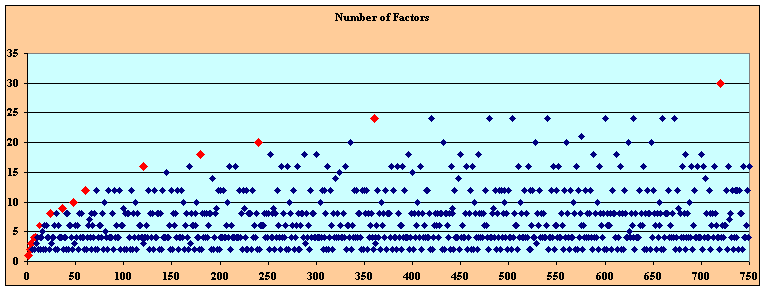
Graph You
can plot the number of factors, d(n), against n. The red dots show the
numbers with “first
appearance of bigger d(n)”.
|
||||||||||||||||||||||||||||||
|
Table
As
you can see, the number 360 has 24 factors. You have to wait until the number
720, which has more factors than 360! |